Your laptop switches off mid-video call, restarts, works fine for an hour, then dies again. Most people blame the battery, update the drivers, or just restart it once more and hope. But sometimes the real problem is buried inside the motherboard, where a restart can never reach it.
Think of a motherboard like a city of roads and power lines. When one area breaks down, nobody demolishes the city — engineers find the exact fault and fix it. A motherboard works the same way: hundreds of tiny components working together, and one bad one can quietly bring down the machine.
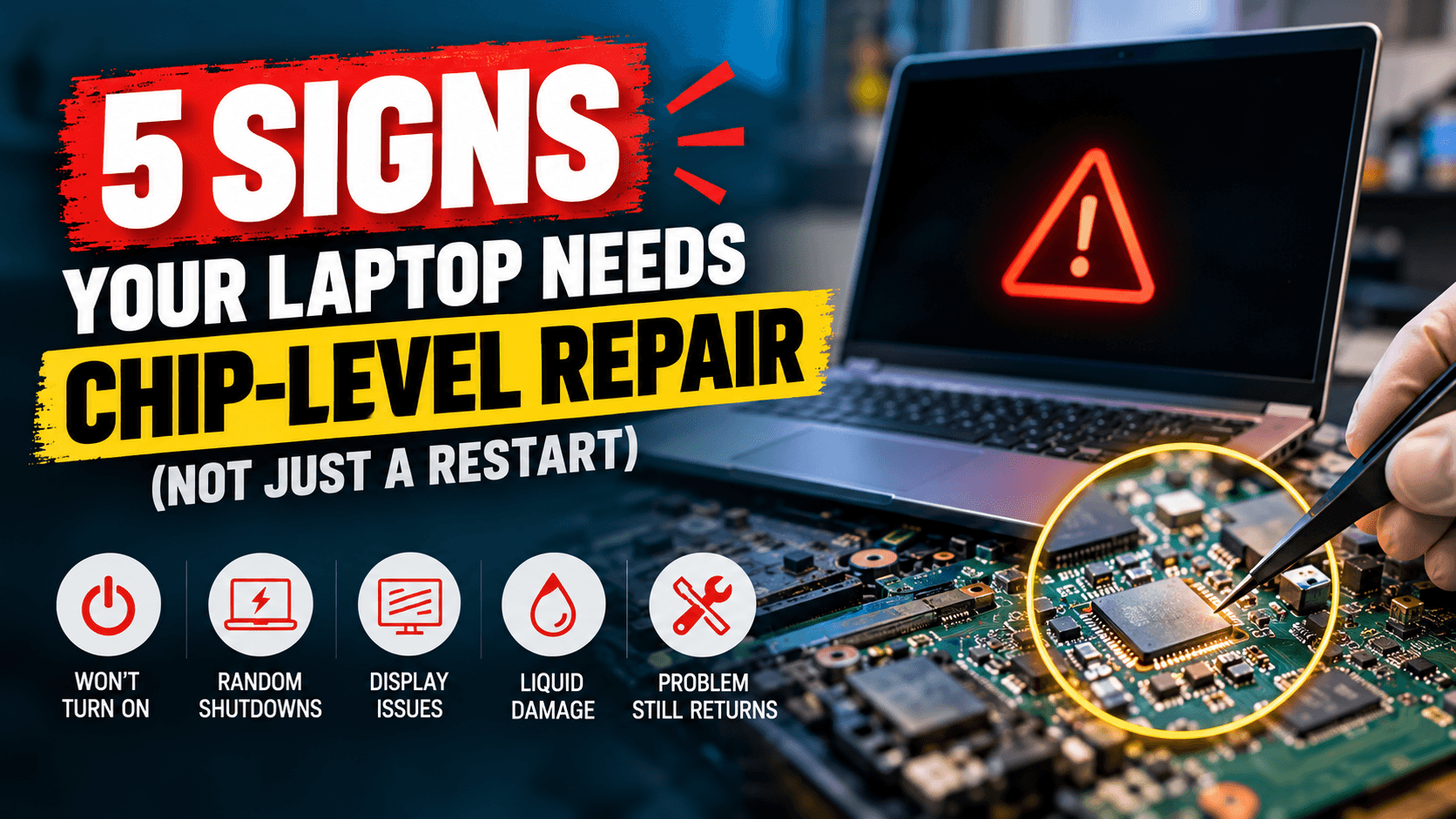
This is where chip level laptop repair comes in. Instead of guessing or swapping expensive parts one by one, a trained technician traces the fault to the exact component using tools like a digital multimeter, a DSO oscilloscope, and schematic diagrams — then fixes only what's broken. Here are five signs your laptop actually needs chip level repair, not another software fix.
1. It Won't Turn On, Even Though It's Charging
If the charging light glows but the screen stays black, the fault is usually in the power section — a damaged inductor, a shorted capacitor, or a faulty power IC blocking the sequence between the DC jack and the CPU. No amount of holding the power button will fix a broken voltage rail. This is a textbook chip level laptop repair case, one that needs voltages tested stage by stage, not parts swapped on guesswork.
2. Random Shutdowns With No Warning
A laptop that shuts down under load — especially during gaming or video editing — is often struggling with heat or a failing power component. Basic card level repair swaps the whole board and hopes the problem disappears. Chip level repair training teaches technicians to trace the exact IC or capacitor at fault using a thermal camera and multimeter, then replace just that part.
3. Display Issues That Aren't the Screen
A flickering display, faint image, or half-lit screen isn't always a broken panel. Sometimes the backlight circuit or graphics chip is at fault. Replacing the screen won't help here, and customers often pay twice before finding a technician who can trace the display circuit.
4. The Spill Damage That Shows Up Weeks Later
Liquid damage rarely kills a laptop instantly. It corrodes tracks and components over weeks, causing faults that come and go. A laptop repairing course covers this diagnosis, using a stereo zoom microscope to spot corrosion before it causes total failure.
5. New Parts Were Installed, But the Problem Came Back
If a laptop has already had a new battery, charger, or motherboard — and the issue keeps returning — the real fault was never found. This is why customers walk into a chip level repair centre frustrated and out of money.
Why This Matters for Your Career, Too
These five signs aren't just useful for laptop owners. They're the everyday reality for anyone learning chip level laptop repair as a profession — needing schematic reading, voltage testing, and hands-on practice on live boards.
At Laptian Technical Institute in Pune, students train on real customer motherboards, not just theory slides. If this kind of diagnostic thinking interests you as a career, explore our chip level laptop repair course and see where a proper technical foundation can take you.
Quick Questions Before You Decide
- Do I need an engineering background to learn this?
- No. Basic computer familiarity is enough. A good chip level repairing course starts from basic electronics and builds up to motherboard practicals step by step.
- How long does it actually take to learn?
- Most complete courses run 2 to 3 months, including hands-on lab hours diagnosing and repairing live customer motherboards — not just watching demonstrations.
- Is this really a solid career option in India?
- Yes. With millions of laptop users and few technicians who can go beyond card-level swaps, chip level repair stays a high-demand, future-proof skill — whether you want a job, freelance work, or your own shop.
- What if I want to start my own repair shop later?
- It's realistic. A basic setup — multimeter, DC power supply, rework station, and soldering kit — can start around forty to fifty thousand rupees, and expand gradually as your client base grows.
- Will I get support finding work after the course?
- A good institute offers real placement assistance and interview opportunities with multi-brand service centres, plus guidance if you'd rather build your own business.
Ready to Stop Guessing and Start Diagnosing?
Book a free demo class, or visit our Pimpri-Chinchwad centre to watch a live motherboard repair in action. Explore our courses at Laptian Technical Institute and take the first step toward a real diagnostic career.